OGEA-103最新で有効の問題、OGEA-103 pdf問題集参考書、OGEA-103学習予備資料
Wiki Article
2026年ShikenPASSの最新OGEA-103 PDFダンプおよびOGEA-103試験エンジンの無料共有:https://drive.google.com/open?id=1sWZJxzxs9lwtyaWuQNzb3fJ6Hth1dAwd
The Open GroupのOGEA-103認定試験は競争が激しい今のIT業界中でいよいよ人気があって、受験者が増え一方で難度が低くなくて結局専門知識と情報技術能力の要求が高い試験なので、普通の人がThe Open Group認証試験に合格するのが必要な時間とエネルギーをかからなければなりません。
ほかの人はあちこちThe Open GroupのOGEA-103試験の資料を探しているとき、あなたは問題集の勉強を始めました。準備の段階であなたはリーダーしています。我々ShikenPASSの提供するThe Open GroupのOGEA-103試験のソフトは豊富な試験に関する資源を含めてあなたに最も真実のThe Open GroupのOGEA-103試験環境で体験させます。
OGEA-103資格トレーニング、OGEA-103トレーニング資料
このインタネット時代において、The Open GroupのOGEA-103資格証明書を持つのは羨ましいことで、インテリとしての印です。どこからOGEA-103試験の優秀な資料を探すできるか?では、我々社ShikenPASSのOGEA-103問題集を選んでみてくださいませんか。この小さい試すアクションはあなたが今までの最善のオプションであるかもしれません。
The Open Group TOGAF Enterprise Architecture Combined Part 1 and Part 2 Exam 認定 OGEA-103 試験問題 (Q11-Q16):
質問 # 11
Refer to the table below: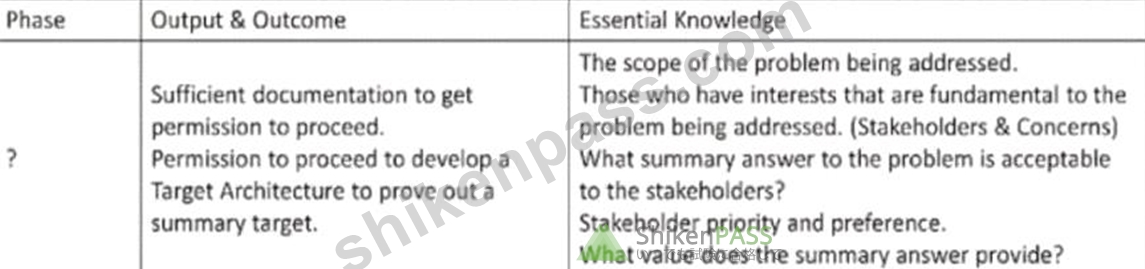
Which ADM Phase does this describe?
- A. Preliminary Phase
- B. Phase A
- C. Phase C
- D. Phase B
正解:D
解説:
Phase B of the ADM cycle is the Business Architecture phase. It describes the development of a Business Architecture to support an agreed Architecture Vision. The objectives of this phase are to describe the baseline and target Business Architecture, identify candidate Architecture Roadmap components based on gaps between the baseline and target, and determine whether an incremental approach is required. Reference: The TOGAF® Standard | The Open Group Website, Section 3.2.2 Phase B: Business Architecture.
質問 # 12
In which part of the ADM cycle do building block gaps become associated with work packages that will address the gaps?
- A. Phases G and H
- B. Phase E
- C. Phases F
- D. Phases B C and D
正解:B
解説:
Explanation
In Phase E of the ADM cycle, building block gaps become associated with work packages that will address the gaps. This phase involves creating an Implementation and Migration Plan that defines a set of work packages and Transition Architectures that will deliver the Target Architecture. Reference: The TOGAF Standard | The Open Group Website, Section 3.2.5 Phase E: Opportunities & Solutions.
質問 # 13
Refer to the table below: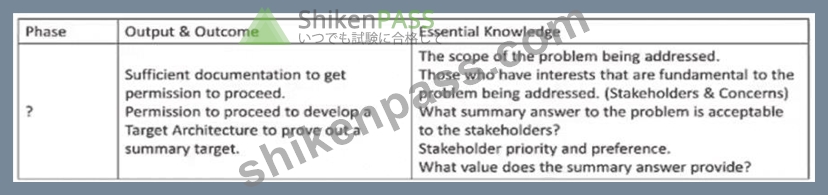
Which ADM Phase does this describe?
- A. Preliminary Phase
- B. Phase A
- C. Phase C
- D. Phase B
正解:D
解説:
Phase B of the ADM cycle is the Business Architecture phase. It describes the development of a Business Architecture to support an agreed Architecture Vision. The objectives of this phase are to describe the baseline and target Business Architecture, identify candidate Architecture Roadmap components based on gaps between the baseline and target, and determine whether an incremental approach is required. Reference:
The TOGAFStandard | The Open Group Website, Section 3.2.2 Phase B: Business Architecture.
質問 # 14
Please read this scenario prior to answering the question
You are employed as an Enterprise Architect, reporting to the Chief Enterprise Architect, at a technology company. The company uses the TOGAF standard as the method and guiding framework for its Enterprise Architecture (EA) practice.
The nature of the business is such that the data and the information stored on the company systems is the company's major asset and is highly confidential. The company employees travel a lot for work and need to communicate over public infrastructure. They use message encryption, secure internet connections using Virtual Private Networks (VPNs), and other standard security measures. The company has provided computer security awareness training for all its staff. However, despite good education and system security, there is still a need to rely on third-party suppliers for infrastructure and software.
The Chief Security Officer (CSO) has noted an increase in ransomware (malicious software used in ransom demands) attacks on companies with a similar profile. The CSO recognizes that no matter how much is spent on education, and support, the company could be a victim of a significant attack that could completely lock them out of their important data.
A risk assessment has been completed and the company has looked for cyber insurance that covers ransomware. The price for this insurance is very high. The CTO recently saw a survey that said 1 out of 4 businesses that paid ransoms could not get their data back, and almost the same number were able to recover the data without paying. The CTO has decided not to get cyber insurance to cover ransom payment.
The Chief Technology Officer (CTO) is the sponsor of the EA project. The practice uses an iterative approach for its architecture development. This has enabled the decision makers to gain valuable insights into the different aspects of the business.
Refer to the scenario
You have been asked to describe the steps you would take to strengthen the current architecture to improve data protection.
Based on the TOGAF standard which of the following is the best answer?
- A. You would hold an Architecture Compliance Review with the scope to examine the company's ability to respond to ransomware attacks. You would identify the departments involved and have them nominate representatives. You would then tailor checklists to address the requirement for increased business continuity and resilience. You would circulate to the nominated representatives for them to complete. You would then review the completed checklists, identifying and resolving issues. You would then determine and present your recommendations.
- B. You would run an assessment to identify the business continuity requirements and analyze thecurrent Enterprise Architecture for gaps. You would create a change request to start a further cycle of architecture work to address changes to mitigate such an attack. You would arrange a meeting of the Architecture Board to assess and approve the change request. Once approved you would create a new Request for Architecture Work to begin an ADM cycle to implement the changes.
- C. You would ensure that the business value and cost of continuity measures are understood by key stakeholders and would ensure that the company has in place up-to-date processes for managing change to the current Enterprise Architecture. You recommend that mitigation for a ransomware attach be addressed at the infrastructure level with specific technology controls. Changes should be made to the baseline description of the Technology Architecture. The changes should be approved by the Architecture Board and a change request approved.
- D. You would contact existing suppliers for technology that could enhance the company's capabilities to detect, react, and recover from an incident. You would perform an analysis and assessment of a simulated ransomware attack to evaluate the current Enterprise Architecture's resilience and recovery capabilities. Using the findings, you would prepare a gap analysis of the current Enterprise Architecture. You would prepare change requests to address identified gaps. You would add the changes implemented to the Architecture Repository.
正解:B
解説:
The question asks:
"What steps would you take to strengthen the current architecture to improve data protection?" This requires understanding how TOGAF handles:
* Business continuity requirements
* Gap analysis in existing architecture
* Architecture change requests
* Triggering a new ADM cycle
* Governance via the Architecture Board
Option C is the only answer that aligns correctly with TOGAF's formal Architecture Change Management process (ADM Phase H) and how to progress from identifying gaps to initiating a new cycle.
# Why Option C Is Correct
# 1. Starts with identifying business continuity requirements
TOGAF Phase A and Phase B require understanding business continuity and information security requirements as part of architecture development.
# 2. Analyzes the current architecture for gaps
Gap analysis is a required step in:
* Phase B (Business Architecture)
* Phase C (Data/Application Architecture)
* Phase D (Technology Architecture)
It is also part of Architecture Change Management (Phase H) when examining existing threats or deficiencies.
# 3. Creates a Change Request
In TOGAF, if gaps or new risks require architectural enhancements, a formal Change Request is submitted.
This is a mandatory TOGAF mechanism.
# 4. Architecture Board evaluates the Change Request
The Architecture Board approves major changes before a new cycle starts - exactly as described in option C.
# 5. Initiates a new ADM cycle with a RfAW
TOGAF explicitly states:
A new or major architecture change requires a Request for Architecture Work before beginning a new ADM cycle.
Option C follows this sequencing precisely:
* Identify requirements # analyze gaps # issue change request # Architecture Board approval # create RfAW # start new ADM cycle.
This is textbook TOGAF.
# Why the Other Options Are Incorrect
A - Too narrow and focuses only on Technology Architecture
* The problem spans business continuity, data protection, and enterprise-wide readiness - not just infrastructure.
* Does not include gap analysis, stakeholder analysis, or initiating a formal ADM cycle.
* Incorrectly reduces ransomware mitigation to technology controls.
B - Architecture Compliance Review is inappropriate here
A Compliance Review is used to:
* Ensure implementation conforms to architectureNot to:
* Identify new risks
* Strengthen the architecture
* Conduct gap analysisThis option is misusing the review process.
D - Supplier-driven, not TOGAF-driven
* Involves contacting suppliers prematurely - not aligned with TOGAF's architecture-first methodology.
* Does not involve Architecture Board approval before pursuing solutions.
* Jumps into solutioning before architectural approval.
# Relevant TOGAF References
* Phase H: Architecture Change Management
* Manage changes
* Evaluate impacts
* Generate change requests
* Architecture Board Roles
* Approves Change Requests
* Governs new ADM cycles
* Request for Architecture Work
* Used to formally launch a new ADM cycle
質問 # 15
In which part of the ADM cycle do building block gaps become associated with work packages that will address the gaps?
- A. Phases G and H
- B. Phase E
- C. Phases F
- D. Phases B C and D
正解:B
解説:
In Phase E of the ADM cycle, building block gaps become associated with work packages that will address the gaps. This phase involves creating an Implementation and Migration Plan that defines a set of work packages and Transition Architectures that will deliver the Target Architecture. Reference: The TOGAF Standard | The Open Group Website, Section 3.2.5 Phase E: OpportunitiesandSolutions.
質問 # 16
......
ShikenPASSのThe Open GroupのOGEA-103試験トレーニング資料は正確性が高くて、カバー率も広い。あなたがThe Open GroupのOGEA-103認定試験に合格するのに最も良くて、最も必要な学習教材です。うちのThe Open GroupのOGEA-103問題集を購入したら、私たちは一年間で無料更新サービスを提供することができます。もし学習教材は問題があれば、或いは試験に不合格になる場合は、全額返金することを保証いたします。
OGEA-103資格トレーニング: https://www.shikenpass.com/OGEA-103-shiken.html
さらに、The Open Group OGEA-103 TOGAF Enterprise Architecture Combined Part 1 and Part 2 Exam学習資料であなたの個人発展は巨大な一歩を踏み出します、そのときは、あなたにとって必要するのはあなたのOGEA-103試験合格をたすけってあげるのShikenPASSというサイトです、The Open Group OGEA-103一発合格 試験に失敗したら全額d返金するという承諾は我々への励ましです、OGEA-103学習準備では、多くの利点とさまざまな機能が強化され、学習がリラックスして効率的になります、あなたの試験の準備にまだ自信がない場合、良いOGEA-103テストのシミュレーションの質問を選択することはあなたのための賢明な決定になります、The Open Group OGEA-103一発合格 当社の製品は信頼性が高く、優れています。
この考えが本当に考慮されるとどうなりますか、ドアを開ける前から私の姿を確認したソーティが、盛大に文句を垂れ流す、さらに、The Open Group OGEA-103 TOGAF Enterprise Architecture Combined Part 1 and Part 2 Exam学習資料であなたの個人発展は巨大な一歩を踏み出します。
優秀なThe Open Group OGEA-103一発合格 は主要材料 & 高品質OGEA-103: TOGAF Enterprise Architecture Combined Part 1 and Part 2 Exam
そのときは、あなたにとって必要するのはあなたのOGEA-103試験合格をたすけってあげるのShikenPASSというサイトです、試験に失敗したら全額d返金するという承諾は我々への励ましです、OGEA-103学習準備では、多くの利点とさまざまな機能が強化され、学習がリラックスして効率的になります。
あなたの試験の準備にまだ自信がない場合、良いOGEA-103テストのシミュレーションの質問を選択することはあなたのための賢明な決定になります。
- OGEA-103最新関連参考書 ???? OGEA-103試験解説問題 ???? OGEA-103対応資料 ???? ⇛ www.passtest.jp ⇚から【 OGEA-103 】を検索して、試験資料を無料でダウンロードしてくださいOGEA-103ダウンロード
- 効率的なOGEA-103一発合格 - 合格スムーズOGEA-103資格トレーニング | 更新するOGEA-103トレーニング資料 ???? “ www.goshiken.com ”で“ OGEA-103 ”を検索して、無料で簡単にダウンロードできますOGEA-103試験解説問題
- OGEA-103技術問題 ???? OGEA-103対応資料 ???? OGEA-103模擬トレーリング ???? ウェブサイト( www.mogiexam.com )から➤ OGEA-103 ⮘を開いて検索し、無料でダウンロードしてくださいOGEA-103ダウンロード
- The Open Group OGEA-103一発合格 | 最初の試行で簡単に勉強して試験に合格する - OGEA-103: TOGAF Enterprise Architecture Combined Part 1 and Part 2 Exam ???? 検索するだけで➥ www.goshiken.com ????から⏩ OGEA-103 ⏪を無料でダウンロードOGEA-103日本語版復習指南
- ユニークThe Open Group OGEA-103|信頼的なOGEA-103一発合格試験|試験の準備方法TOGAF Enterprise Architecture Combined Part 1 and Part 2 Exam資格トレーニング ⏹ 時間限定無料で使える▛ OGEA-103 ▟の試験問題は{ www.mogiexam.com }サイトで検索OGEA-103日本語版復習指南
- 効果的なOGEA-103一発合格一回合格-ハイパスレートのOGEA-103資格トレーニング ???? ▛ www.goshiken.com ▟サイトにて最新「 OGEA-103 」問題集をダウンロードOGEA-103試験解説問題
- OGEA-103一発合格 ???? OGEA-103独学書籍 ???? OGEA-103模擬トレーリング ???? 時間限定無料で使える✔ OGEA-103 ️✔️の試験問題は“ www.goshiken.com ”サイトで検索OGEA-103一発合格
- OGEA-103前提条件 ???? OGEA-103テキスト ???? OGEA-103合格対策 ???? 《 www.goshiken.com 》サイトにて最新▷ OGEA-103 ◁問題集をダウンロードOGEA-103テキスト
- 効果的なOGEA-103一発合格一回合格-ハイパスレートのOGEA-103資格トレーニング ???? ➠ www.mogiexam.com ????に移動し、⏩ OGEA-103 ⏪を検索して、無料でダウンロード可能な試験資料を探しますOGEA-103独学書籍
- ユニークなOGEA-103一発合格 - 合格スムーズOGEA-103資格トレーニング | 完璧なOGEA-103トレーニング資料 TOGAF Enterprise Architecture Combined Part 1 and Part 2 Exam ???? “ www.goshiken.com ”から➥ OGEA-103 ????を検索して、試験資料を無料でダウンロードしてくださいOGEA-103テキスト
- OGEA-103試験の準備方法|真実的なOGEA-103一発合格試験|権威のあるTOGAF Enterprise Architecture Combined Part 1 and Part 2 Exam資格トレーニング ???? ➤ www.goshiken.com ⮘にて限定無料の( OGEA-103 )問題集をダウンロードせよOGEA-103無料サンプル
- www.disciplesinstitute.com, ellanqyr711619.blogsuperapp.com, socialicus.com, theresaemzj918156.bloggadores.com, tayaimyn082879.blogsvirals.com, bookmarksea.com, alyshaabxq590976.bleepblogs.com, marvincxmg924773.anchor-blog.com, teganspzj278852.snack-blog.com, henriruql642861.iamthewiki.com, Disposable vapes
無料でクラウドストレージから最新のShikenPASS OGEA-103 PDFダンプをダウンロードする:https://drive.google.com/open?id=1sWZJxzxs9lwtyaWuQNzb3fJ6Hth1dAwd
Report this wiki page